

Table of Contents
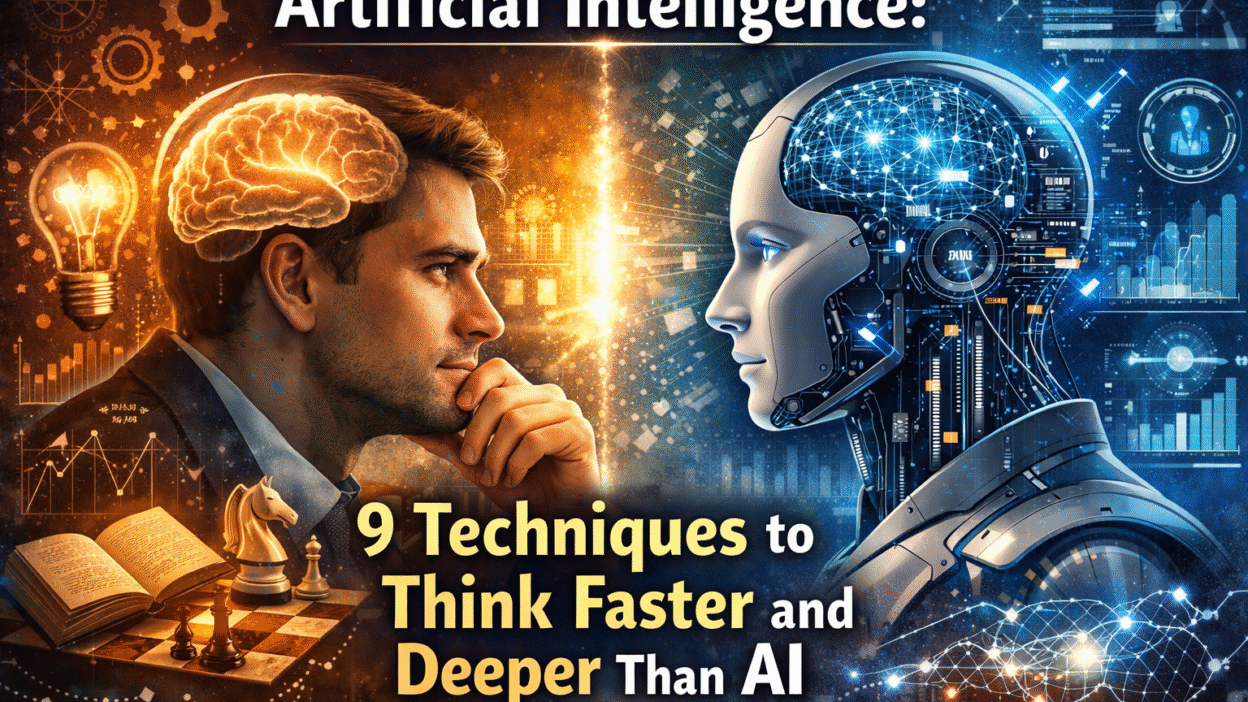
Artificial Intelligence has fundamentally reshaped the way humans work, learn, and solve problems. From automating repetitive tasks to processing massive volumes of data and generating insights in seconds, Artificial Intelligence has introduced unprecedented speed and efficiency into nearly every industry. Its ability to analyze patterns, predict outcomes, and execute instructions at scale often creates the impression that machines are becoming faster—and even smarter—than human minds.
However, speed and computational power should not be mistaken for deep thinking. Artificial Intelligence excels at optimization, but it does not understand meaning, intent, or consequence in the way humans do. It processes information, yet it does not truly comprehend it. Human intelligence, by contrast, operates on multiple dimensions simultaneously—integrating context, emotion, ethical judgment, creativity, and lived experience. These uniquely human qualities allow us to navigate ambiguity, make value-based decisions, and imagine possibilities beyond existing data.
While Artificial Intelligence relies on historical inputs and predefined models, humans can question assumptions, redefine problems, and generate original ideas. Creativity, intuition, and wisdom emerge not from algorithms, but from reflection, curiosity, and experience. This is where human cognition retains a decisive advantage—especially in complex, uncertain, and rapidly changing environments.
To think faster and deeper than Artificial Intelligence, humans must intentionally strengthen the cognitive skills that machines cannot replicate. This means cultivating critical thinking, sharpening self-awareness, and learning how to connect ideas across disciplines rather than processing information in isolation. It also requires slowing down when necessary to gain clarity, challenge biases, and consider long-term implications—an ability Artificial Intelligence does not possess.
The future does not belong to those who try to compete with Artificial Intelligence on speed alone, but to those who understand how to think beyond it. By developing deeper insight, emotional intelligence, and strategic perspective, humans can outperform Artificial Intelligence in the areas that matter most—innovation, leadership, ethical reasoning, and purposeful decision-making.
Below are nine proven techniques that empower humans to think faster and deeper than Artificial Intelligence, not by rejecting technology, but by mastering the uniquely human skills that no machine can replace.
1. Master First-Principles Thinking
First-principles thinking is one of the most powerful ways humans can think faster and deeper than Artificial Intelligence. While Artificial Intelligence depends heavily on existing data, historical patterns, and learned correlations, first-principles thinking strips a problem down to its most basic truths and rebuilds understanding from the ground up. Instead of asking “How has this been done before?” it asks “What is fundamentally true here?”
Artificial Intelligence excels at extrapolating from what already exists. It identifies trends, predicts outcomes, and optimizes processes based on prior information. However, it rarely challenges the assumptions embedded within that data. Humans, on the other hand, can question those assumptions entirely. By breaking complex problems into their core components, first-principles thinking allows humans to bypass conventional limitations and arrive at original solutions that Artificial Intelligence would not naturally produce.
This approach requires deliberate mental effort. It involves identifying what is absolutely necessary, separating facts from opinions, and eliminating inherited beliefs that may no longer be valid. When practiced consistently, first-principles thinking accelerates clarity. Instead of navigating through layers of noise, comparisons, and conventions, the mind works directly with foundational truths. This leads to faster decision-making and deeper insight—two areas where Artificial Intelligence often appears strong but lacks true understanding. Harvard Business Review
In innovation, strategy, and leadership, first-principles thinking creates breakthroughs rather than incremental improvements. Artificial Intelligence may suggest better versions of existing ideas, but humans using first principles can redefine the problem entirely. This is how new business models, technologies, and philosophies emerge. It is also why human reasoning remains essential in environments marked by uncertainty, ambiguity, and rapid change.
Ultimately, mastering first-principles thinking allows humans to operate independently of algorithmic constraints. It shifts thinking from reactive to generative, from pattern-following to principle-driven. In a world increasingly influenced by Artificial Intelligence, this skill ensures that human intelligence remains not only relevant, but indispensable.
2. Develop Deep Contextual Understanding
Deep contextual understanding is a defining advantage of human intelligence and a critical way to think beyond Artificial Intelligence. While Artificial Intelligence processes information by analyzing data points and statistical relationships, it often lacks a genuine grasp of context—the subtle, interconnected factors that give information meaning. Humans, by contrast, naturally interpret situations through layers of cultural, emotional, historical, and situational awareness.
Artificial Intelligence can identify what is happening, but humans understand why it is happening and why it matters. Context allows people to recognize nuance, read between the lines, and adjust their thinking based on circumstances that cannot be fully captured by data. Tone, intention, timing, social dynamics, and unspoken expectations all influence outcomes, yet these elements are difficult for Artificial Intelligence to evaluate accurately without explicit instruction.
Developing deep contextual understanding means training the mind to look beyond surface-level facts. It involves asking broader questions, such as how a decision will affect people over time, how cultural norms influence behavior, or how past events shape present conditions. This ability enables humans to make judgments that are flexible rather than rigid, adaptive rather than purely rule-based—something Artificial Intelligence struggles to achieve in unpredictable environments.McKinsey
In professional settings, contextual intelligence is especially valuable in leadership, communication, and problem-solving. Artificial Intelligence may generate recommendations based on optimal models, but humans must decide whether those recommendations align with real-world constraints, ethical considerations, and human emotions. A technically correct answer can still fail if it ignores context, and this is where human insight becomes indispensable.
Ultimately, deep contextual understanding transforms information into wisdom. It allows humans to synthesize knowledge across domains, anticipate unintended consequences, and respond thoughtfully rather than mechanically. As Artificial Intelligence continues to advance, the ability to understand context will remain a distinctly human strength—one that enables deeper thinking, better decisions, and more meaningful outcomes.
3. Practice Metacognition (Thinking About Thinking)
Metacognition—the ability to think about one’s own thinking—is a uniquely human skill that provides a powerful advantage over Artificial Intelligence. While Artificial Intelligence can execute complex tasks and refine outputs based on feedback, it does not possess true self-awareness. It cannot genuinely reflect on how or why it reached a conclusion, nor can it consciously evaluate the quality of its reasoning. Humans, however, can step back, observe their own thought processes, and deliberately improve them.
Practicing metacognition means becoming aware of mental habits, assumptions, biases, and emotional influences that shape decisions. Instead of reacting automatically, humans can pause to examine whether their thinking is accurate, complete, or distorted. This reflective capacity enables faster learning and deeper understanding because mistakes are not merely corrected—they are analyzed and internalized as lessons. Artificial Intelligence adjusts parameters; humans develop wisdom. Psychology
Artificial Intelligence operates within predefined models and objectives. It optimizes performance but does not question its goals or the framework in which it operates. Metacognitive humans, on the other hand, can challenge the very structure of a problem. They can ask whether the right questions are being asked, whether alternative perspectives exist, and whether a different mental approach would lead to better outcomes. This flexibility allows humans to adapt more effectively in complex or novel situations.
In decision-making, metacognition enhances accuracy and resilience. By recognizing cognitive biases such as overconfidence, confirmation bias, or emotional reasoning, individuals can recalibrate their judgments in real time. This leads to clearer thinking under pressure—something Artificial Intelligence cannot truly achieve when faced with ambiguous or morally complex scenarios.
Ultimately, metacognition transforms thinking from an unconscious process into a strategic skill. It empowers humans to continuously refine how they learn, reason, and decide. In an era dominated by Artificial Intelligence, the ability to reflect on and improve one’s own thinking is not just an advantage—it is a cornerstone of deeper intelligence and long-term adaptability.
4. Strengthen Pattern Recognition Beyond Data
Pattern recognition is often cited as one of the greatest strengths of Artificial Intelligence. Algorithms excel at detecting correlations across vast datasets, identifying trends, and predicting outcomes based on statistical regularities. However, human pattern recognition operates on a much deeper and broader level—one that extends far beyond data alone. Strengthening this uniquely human ability allows individuals to think in ways that Artificial Intelligence cannot fully replicate.
Artificial Intelligence identifies patterns within the boundaries of structured information. It recognizes what has happened frequently or consistently in the past. Humans, by contrast, can detect patterns across experiences, emotions, behaviors, and abstract concepts. They notice subtle shifts in tone, emerging cultural movements, unspoken tensions, and long-term trajectories that may not yet be visible in data. This form of pattern recognition blends intuition, experience, and judgment into insight.
Developing this skill requires exposure, reflection, and synthesis. When humans consciously connect ideas across disciplines—such as psychology, history, business, and art—they begin to see recurring themes and causal relationships that Artificial Intelligence would treat as unrelated. This holistic pattern recognition enables foresight rather than mere prediction. It allows individuals to anticipate change before it becomes measurable.
In leadership and innovation, this ability is especially valuable. Many transformative ideas emerge not from analyzing spreadsheets, but from sensing gaps, inconsistencies, or emerging needs. Artificial Intelligence may confirm trends once they exist, but humans often recognize them while they are still forming. This early insight creates strategic advantage and fuels creative breakthroughs.
Ultimately, strengthening pattern recognition beyond data shifts thinking from reactive to visionary. It enables humans to interpret complexity with nuance, draw meaning from ambiguity, and act decisively in uncertain conditions. As Artificial Intelligence continues to advance in analytical power, human intuition and experiential pattern recognition will remain essential for deep understanding and forward-thinking judgment.
5. Ask Better Questions, Not Just Faster Answers
One of the most important ways humans can think deeper than Artificial Intelligence is by mastering the art of asking better questions. Artificial Intelligence is designed to deliver answers—often quickly, efficiently, and at scale. However, it does not determine which questions are worth asking in the first place. Humans define the direction of inquiry, and the quality of their thinking depends largely on the quality of the questions they pose.
Artificial Intelligence responds to prompts based on existing data and learned patterns. If a question is narrow, flawed, or based on incorrect assumptions, the answer—no matter how sophisticated—will be limited. Humans, by contrast, can step back and challenge the framing of a problem itself. They can ask whether the right issue is being addressed, whether alternative perspectives exist, or whether deeper causes lie beneath surface symptoms. This ability transforms problem-solving from reactive to strategic.
Asking better questions requires curiosity, humility, and critical thinking. It means moving beyond what and how toward why, what if, and what matters most. These exploratory questions open space for creativity, ethical reflection, and long-term thinking—areas where Artificial Intelligence has no intrinsic understanding. By questioning assumptions and reframing challenges, humans often uncover insights that algorithms alone would never reveal.
In professional and creative contexts, powerful questions drive innovation and leadership. Breakthroughs often begin with a simple but profound inquiry: Why must it be done this way? or What happens if we remove this constraint? Artificial Intelligence can support exploration, but it is human curiosity that initiates it. Without meaningful questions, even the most advanced Artificial Intelligence produces only incremental improvement.
Ultimately, the ability to ask better questions defines intellectual depth. While Artificial Intelligence accelerates access to information, humans determine its purpose and significance. By cultivating thoughtful inquiry, humans ensure that intelligence remains guided by insight, intention, and wisdom—not just speed and output.
6. Integrate Emotional Intelligence
Emotional intelligence is a critical dimension of human thinking that Artificial Intelligence cannot authentically replicate. While Artificial Intelligence can analyze sentiment, recognize facial expressions, or simulate empathetic responses, it does not experience emotion or understand human feelings in a lived, meaningful way. Humans, however, think and decide through an emotional lens that deeply influences judgment, relationships, and outcomes. Integrating emotional intelligence allows people to think more deeply, wisely, and effectively than Artificial Intelligence.
Emotional intelligence involves recognizing one’s own emotions, understanding the emotions of others, and managing interactions with empathy and awareness. This skill enables humans to interpret subtle cues such as tone of voice, body language, and unspoken concerns—elements that often carry more meaning than explicit data. Artificial Intelligence may detect patterns, but it cannot grasp the emotional context that shapes human behavior and decision-making.
In leadership, collaboration, and negotiation, emotional intelligence is especially powerful. Decisions are rarely based on logic alone; they are influenced by trust, motivation, fear, and values. Humans who integrate emotional intelligence can navigate conflict, inspire others, and build lasting relationships. Artificial Intelligence can offer recommendations, but it cannot build trust or understand moral responsibility in the same way humans do.
Emotional intelligence also enhances self-regulation. By understanding their own emotional responses, individuals can prevent impulsive reactions, reduce cognitive bias, and maintain clarity under pressure. This reflective control leads to better decisions in complex or high-stakes situations—areas where Artificial Intelligence may optimize outcomes without considering human impact.
Ultimately, integrating emotional intelligence transforms thinking from purely analytical to deeply human. It aligns logic with empathy and insight, enabling decisions that are not only effective but also ethical and meaningful. As Artificial Intelligence becomes more advanced, emotional intelligence will remain one of the strongest differentiators of human depth, wisdom, and leadership.
7. Think in Systems, Not Isolated Tasks
Systems thinking is a powerful cognitive skill that enables humans to understand complexity in ways Artificial Intelligence often cannot. While Artificial Intelligence excels at optimizing isolated tasks and solving well-defined problems, it frequently operates within narrow parameters. Humans, by contrast, can perceive how multiple elements interact within a larger system—recognizing relationships, feedback loops, and long-term consequences that extend beyond a single objective.
Artificial Intelligence typically focuses on maximizing predefined outcomes. It improves efficiency within a given framework but does not inherently understand how changes in one area may influence others over time. Humans who think in systems can anticipate ripple effects across economic, social, ethical, and environmental dimensions. This broader perspective allows for more resilient and sustainable decision-making, especially in complex real-world environments.
Developing systems thinking requires stepping back from immediate details and viewing problems holistically. It involves identifying interdependencies, understanding cause-and-effect relationships, and recognizing that short-term gains can produce long-term challenges. Humans can weigh trade-offs, balance competing priorities, and adapt strategies as systems evolve—abilities that Artificial Intelligence struggles to replicate without extensive human guidance.
In leadership and strategy, systems thinking is indispensable. Organizational decisions rarely affect only one department or outcome. Cultural dynamics, human behavior, market forces, and external risks all interact simultaneously. While Artificial Intelligence can provide valuable insights, humans must interpret those insights within the broader system to ensure alignment with values, goals, and long-term vision.
Ultimately, thinking in systems elevates intelligence from task execution to strategic foresight. It enables humans to design solutions that are adaptive rather than fragile, and meaningful rather than purely efficient. As Artificial Intelligence continues to advance, systems thinking will remain a uniquely human strength—essential for navigating complexity and shaping sustainable futures.
8. Slow Down to Think Faster
At first glance, slowing down may seem counterintuitive in a world driven by speed and instant results—especially when compared to the rapid processing power of Artificial Intelligence. Machines analyze data in milliseconds, producing outputs almost instantly. However, speed alone does not guarantee quality, accuracy, or wisdom. In many cases, deliberately slowing down enables humans to think more clearly, avoid costly errors, and ultimately arrive at better decisions faster than Artificial Intelligence.
Artificial Intelligence operates continuously and without reflection. It executes instructions based on available data and predefined objectives, regardless of uncertainty or ambiguity. Humans, on the other hand, benefit from pauses that allow for evaluation, insight, and recalibration. By slowing down, people create mental space to question assumptions, consider alternative perspectives, and assess long-term implications—steps that prevent shallow or misguided conclusions.
This intentional pause is especially valuable in complex or high-stakes situations. Rushed thinking often leads to cognitive bias, emotional reactions, and incomplete analysis. Slower, more deliberate thinking improves focus and depth, reducing the need for rework or corrective action later. While Artificial Intelligence may generate rapid answers, humans who reflect before acting often reach more accurate and sustainable outcomes.
Slowing down also enhances creativity and insight. Breakthrough ideas rarely emerge under constant pressure; they arise when the mind has time to connect ideas, recognize patterns, and explore possibilities. Artificial Intelligence recombines existing information efficiently, but it does not benefit from reflection or incubation in the way human creativity does.
Ultimately, slowing down is not about reducing productivity—it is about increasing effectiveness. By choosing depth over haste, humans leverage their greatest cognitive advantage: the ability to reflect, adapt, and think with intention. In a fast-paced world shaped by Artificial Intelligence, the discipline to slow down becomes a strategic advantage that leads to faster, wiser thinking in the long run.
9. Combine Human Judgment with Artificial Intelligence
The ultimate way humans can think faster and deeper than Artificial Intelligence is not by competing with it, but by collaborating with it intelligently. Artificial Intelligence is an extraordinary tool: it can process massive datasets, identify patterns invisible to humans, and generate insights at incredible speed. However, without human judgment, these outputs risk being incomplete, contextually insensitive, or ethically questionable. The true advantage lies in integrating human insight with Artificial Intelligence, creating a synergy that neither can achieve alone.
Artificial Intelligence excels at providing recommendations, simulations, and predictive analytics. Yet it lacks the ability to weigh values, consider long-term consequences, or interpret subtle nuances of human behavior. Humans, on the other hand, bring intuition, creativity, ethical reasoning, and contextual awareness to the table. By using Artificial Intelligence to amplify our cognitive capabilities—while guiding it with judgment and purpose—we can make faster, more informed, and more meaningful decisions than either humans or machines could independently.
This integration requires deliberate practice. It involves questioning outputs critically, interpreting results in context, and adjusting strategies when data or algorithms fail to capture the bigger picture. In innovation, business strategy, medicine, and policymaking, humans who effectively combine their judgment with Artificial Intelligence achieve superior outcomes—solutions that are both efficient and responsible.
Ultimately, the goal is not to outpace Artificial Intelligence in speed or computation, but to think beyond it. Humans who embrace this partnership leverage the strengths of both worlds: the analytical power of Artificial Intelligence and the reflective, ethical, and creative intelligence unique to people. In doing so, we unlock the potential to solve complex problems, anticipate challenges, and innovate in ways that machines alone cannot imagine.
Conclusion
While Artificial Intelligence continues to advance at an unprecedented pace, human intelligence remains uniquely powerful in areas that machines cannot replicate. Speed, data processing, and pattern recognition may give Artificial Intelligence an edge in execution, but deep thinking—rooted in creativity, context, ethical judgment, and emotional awareness—remains a distinctly human strength.
By mastering first-principles thinking, developing contextual insight, practicing metacognition, strengthening intuitive pattern recognition, asking better questions, integrating emotional intelligence, thinking in systems, slowing down to reflect, and combining judgment with Artificial Intelligence, humans can not only keep pace with machines but surpass them in meaningful ways.
Ultimately, the goal is not to compete with Artificial Intelligence but to think beyond it—leveraging technology as a tool while cultivating the uniquely human capabilities that drive innovation, wisdom, and purposeful decision-making. In a world increasingly influenced by Artificial Intelligence, these cognitive skills ensure that humans remain the architects of insight, strategy, and progress.
Read more : 7 Unexpected Ways to Use Artificial Intelligence to Boost Your Daily Creativity


