

Table of Contents
Artificial intelligence has moved far beyond the experimental phase. What was once reserved for research labs and tech giants is now deeply embedded in everyday business operations. Today, organizations of all sizes—from early-stage startups to global enterprises—rely on an Artificial Intelligence to automate complex decisions, analyze massive volumes of data, personalize customer experiences, optimize workflows, and accelerate growth. In many cases, an AI System now influences choices that were once made entirely by humans.
However, the rapid adoption of an AI System comes with significant responsibility. While these technologies can deliver remarkable efficiency, scalability, and cost savings, placing unquestioned trust in an AI System can expose organizations to hidden risks. Inaccurate outputs, biased models, security vulnerabilities, and compliance failures can quietly undermine performance and damage trust—often before leaders realize something has gone wrong. An AI System is not infallible, and without proper oversight, its impact can quickly shift from beneficial to harmful.
Before fully depending on any AI System for core business functions, operational decisions, or strategic planning, it is essential to slow down and evaluate what you are truly relying on. Decision-makers must understand how the Artificial Intelligence works, what data it uses, and where its limitations lie. Asking the right questions early can prevent costly mistakes later.
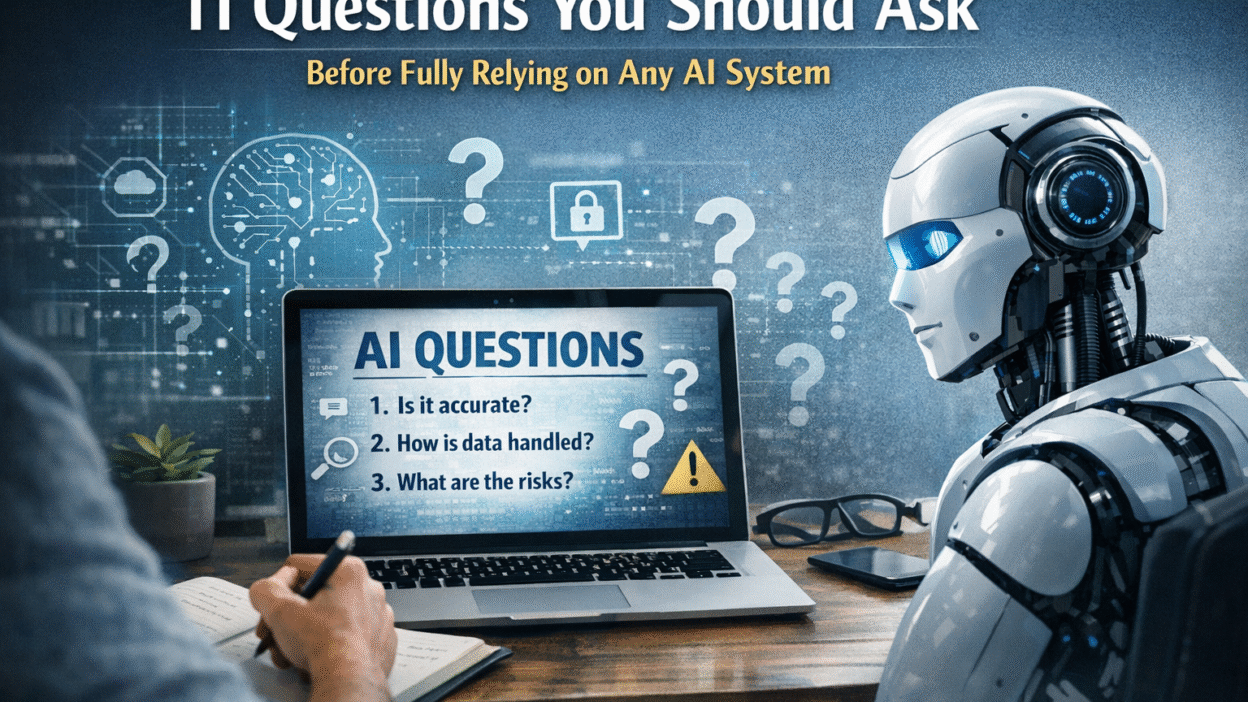
The following 11 questions are designed to help you critically assess any AI System before making it a foundational part of your organization. They focus on reliability, ethics, transparency, scalability, and long-term value—ensuring that the AI System you adopt strengthens your operations rather than becoming a hidden liability. By approaching adoption with clarity and caution, organizations can turn an Artificial Intelligence into a trusted partner that supports sustainable, responsible growth.
1. What Problem Is This AI System Actually Solving?
Before adopting any AI System, organizations must clearly define the problem it is intended to solve. Too often, an Artificial Intelligence is introduced because it appears innovative or because competitors are using similar technology, rather than because it addresses a specific operational or strategic challenge. When the underlying problem is vague, the Artificial Intelligence is unlikely to deliver measurable value. IBM
A well-implemented AI System should be tied to a clearly articulated objective, such as reducing customer response times, improving demand forecasting accuracy, detecting fraud more effectively, or automating repetitive decision-making processes. Without a precise goal, it becomes difficult to measure success, optimize performance, or justify ongoing investment in the Artificial Intelligence.
It is also important to distinguish between problems that genuinely require an AI System and those that can be solved with simpler automation or traditional analytics. Not every challenge benefits from artificial intelligence, and forcing an Artificial Intelligence into the wrong context can add unnecessary complexity and cost.
By clearly defining the problem upfront, organizations create a foundation for success. When the purpose of the Artificial Intelligence is well understood, teams can select the right data, choose appropriate models, and evaluate outcomes against meaningful benchmarks. Ultimately, an AI System delivers real value only when it is designed to solve a real, well-defined problem. MIT
2. How Was the AI System Trained?
Understanding how an Artificial Intelligence was trained is essential before placing trust in its outputs or recommendations. The training process determines how the AI System interprets information, identifies patterns, and makes decisions. Without transparency into this foundation, organizations risk relying on conclusions they do not fully understand or cannot validate.
A critical first step is examining the data used to train the AI System. This includes identifying the sources of the data, how representative it is of real-world conditions, and whether it reflects the specific industry, market, or customer base in which the Artificial Intelligence will operate. An AI System trained on generic or outdated data may struggle to deliver accurate results in specialized or rapidly changing environments.
Equally important is understanding how the training data was prepared. Data cleaning, labeling, and preprocessing decisions can significantly influence how the Artificial Intelligence behaves. Errors or assumptions made during this stage may be amplified once the AI System is deployed at scale. Organizations should also ask whether the AI System continues to learn over time or relies on a fixed training dataset. IBM
By gaining clarity into the training methodology, organizations can better assess the strengths and limitations of an Artificial Intelligence . Transparent training practices build confidence, support better decision-making, and reduce the risk of unexpected outcomes once the Artificial Intelligence becomes part of critical operations.
3. Can the AI System Explain Its Decisions?
One of the most important factors in evaluating an AI System is its ability to explain how it arrives at specific decisions or recommendations. Many advanced models operate as “black boxes,” producing outputs without offering clear insight into the reasoning behind them. While this may be acceptable for low-risk use cases, it becomes a serious concern when an AI System influences critical business, financial, or human-centered decisions.
An explainable AI System allows users to understand which data points, variables, or patterns contributed to a particular outcome. This transparency is especially important in industries subject to regulation, such as healthcare, finance, hiring, and insurance, where organizations must justify decisions to regulators, customers, or employees. Without explainability, it becomes difficult to audit outcomes, resolve disputes, or identify errors within the Artificial Intelligence. IBM
Explainability also plays a key role in trust and adoption. When users can see how an Artificial Intelligence reaches its conclusions, they are more likely to rely on it appropriately and challenge it when something appears incorrect. In contrast, an AI System that provides answers without context may be met with skepticism or misused as an unquestioned authority.
Ultimately, an Artificial Intelligence should support human decision-making, not replace accountability. The ability to explain decisions ensures that organizations remain in control, maintain transparency, and use the AI System responsibly and effectively.
4. What Biases Might Exist in This AI System?
Bias is one of the most significant and widely discussed risks associated with any AI System. Because an AI System learns from historical data, it can unintentionally inherit and amplify existing biases present in that data. If these biases are not identified and addressed, the Artificial Intelligence may produce unfair, inaccurate, or discriminatory outcomes—often at scale.
Organizations should examine whether the Artificial Intelligence has been evaluated for bias across different demographic groups, use cases, and operating conditions. This includes understanding how sensitive attributes are handled and whether fairness metrics are applied during development and deployment. Without intentional safeguards, an Artificial Intelligence may reinforce patterns that disadvantage certain users, customers, or employees.
It is also important to recognize that bias can emerge over time. As real-world conditions change, new data fed into the AI System may introduce unexpected distortions. Regular audits and performance reviews are essential to ensure the Artificial Intelligence continues to operate fairly and consistently. IBM
Addressing bias is not only an ethical responsibility but also a business necessity. An AI System that produces biased outcomes can erode trust, damage brand reputation, and expose organizations to legal and regulatory risk. Proactively identifying and mitigating bias helps ensure the Artificial Intelligence supports equitable, responsible decision-making.
5. How Accurate and Reliable Is the AI System Over Time?
Accuracy is often one of the first metrics considered when evaluating an AI System, but it should never be viewed as a one-time measurement. An AI System that performs exceptionally well during initial testing may experience declining accuracy once it is deployed in real-world conditions. Changes in user behavior, market dynamics, or data patterns can gradually reduce the reliability of the Artificial Intelligence over time.
This decline, often referred to as model drift, occurs when the data the AI System encounters in production no longer matches the data on which it was originally trained. Without continuous monitoring, these shifts can go unnoticed, leading the Artificial Intelligence to make increasingly inaccurate or misleading decisions. Organizations should understand how performance is tracked, which metrics are monitored, and how often the Artificial Intelligence is evaluated after deployment. MIT
Equally important is the process for maintaining accuracy. This includes regular retraining, validation against new datasets, and clearly defined thresholds that trigger human review or corrective action. A dependable AI System is supported by an ongoing improvement cycle rather than a static model left unchanged.
Long-term reliability is what ultimately determines the value of an Artificial Intelligence. By actively monitoring accuracy and adapting to change, organizations can ensure the AI System remains a trusted tool that consistently supports informed decision-making. IBM
6. What Happens When the AI System Fails?
No matter how advanced it may be, no Artificial Intelligence is immune to failure. Errors, unexpected behavior, system outages, or incorrect outputs can and will occur, especially when an AI System is deployed in complex, real-world environments. Understanding how failure is handled is critical before relying on an Artificial Intelligence for essential operations or decisions. MIT
Organizations should evaluate whether there are clear fallback mechanisms in place when the AI System produces questionable results or becomes unavailable. This includes defining when human intervention is required, how overrides are implemented, and who is responsible for making final decisions during a failure scenario. An Artificial Intelligence should enhance human judgment, not eliminate the ability to intervene when necessary.
Equally important is how quickly failures can be detected and addressed. Monitoring tools, alert systems, and escalation procedures help ensure that problems within the Artificial Intelligence are identified before they cause widespread disruption or harm. Without these safeguards, even minor issues can escalate into major operational risks.
A resilient AI System is designed with failure in mind. By planning for errors, maintaining human oversight, and establishing recovery processes, organizations can reduce downtime, limit damage, and continue operating effectively—even when the Artificial Intelligence does not perform as expected. IBM
7. How Secure Is the AI System and Its Data?
Security is a critical consideration when adopting any AI System. These systems often handle sensitive data, including customer information, financial records, or proprietary business intelligence, making them a prime target for cyberattacks. A breach or compromise of an Artificial Intelligence can have far-reaching consequences, from data loss and operational disruption to reputational damage and regulatory penalties.
Before fully relying on an Artificial Intelligence , organizations must understand the security measures in place. Key considerations include data encryption—both at rest and in transit—robust access controls to ensure only authorized personnel can interact with the system, and compliance with industry security standards and regulations. Additionally, it’s important to assess whether the Artificial Intelligence vendor has a clear incident response plan and a history of promptly addressing vulnerabilities. IBM
Security extends beyond technical safeguards. Policies governing data handling, storage, and sharing must be well-defined. Organizations should also understand where data is stored, how it is processed, and who has access to it. Even a highly capable AI System can become a liability if its data is not properly protected.
Ultimately, a secure Artificial Intelligence protects not only sensitive information but also the integrity of the decisions it produces. By prioritizing security at every stage—training, deployment, and ongoing operations—organizations can confidently rely on the AI System while minimizing risk to their data and business operations.
8. Does the AI System Integrate With Existing Tools?
An AI System rarely operates in isolation. To deliver maximum value, it must integrate seamlessly with your organization’s existing software, workflows, and data infrastructure. Poor integration can create silos, disrupt established processes, and reduce the adoption of the Artificial Intelligence by teams who find it difficult or cumbersome to use.
When evaluating an AI System, it is important to ask how it connects with your current tools. Can it communicate effectively with CRM systems, ERP platforms, or analytics dashboards? Does it support automated data flows, or will it require manual intervention to move information between systems? The ease and flexibility of integration directly affect how quickly and effectively the Artificial Intelligence can be operationalized.
Integration also affects scalability. An Artificial Intelligence that cannot connect with other tools may deliver limited insights or require significant customization, slowing adoption and increasing long-term costs. Conversely, an Artificial Intelligence designed to work within your existing technology ecosystem can enhance efficiency, reduce redundancy, and enable teams to make faster, data-driven decisions.
In short, integration is not just a technical concern—it is a critical determinant of whether an Artificial Intelligence truly improves operations or becomes an additional source of complexity. Ensuring seamless compatibility with your existing tools maximizes the value and effectiveness of the AI System across the organization.MIT
Learn more : 7 Ways AI-Driven Innovation Is Turning Science Fiction into Real-World Growth Tools
9. Who Owns the AI System’s Outputs and Data?
Ownership is a crucial consideration before fully relying on any Artificial Intelligence . Beyond the technical performance of the system itself, organizations must clarify who has rights to the data it generates, the insights it produces, and how that information can be used. Failing to address these questions can lead to legal disputes, intellectual property issues, or unintended exposure of sensitive information.
When evaluating an Artificial Intelligence, ask whether the data you input and the outputs generated belong to your organization, the AI System vendor, or a combination of both. Some store or reuse data to improve future models, which may be beneficial but could also create potential privacy or confidentiality concerns. Understanding the terms of data usage and ownership is essential, particularly when dealing with proprietary business information or personal customer data.
Ownership considerations also extend to decision-making insights. For example, if an AI System produces predictive analytics or strategic recommendations, it is important to know who can access, modify, or distribute these insights. Clear agreements and policies help ensure that your organization retains control over critical outputs and can make informed decisions without restrictions imposed by the Artificial Intelligence vendor. IBM
Ultimately, clarifying ownership of both data and outputs ensures that the AI System supports your organization’s objectives while safeguarding intellectual property and regulatory compliance. By addressing these issues upfront, you can confidently integrate the Artificial Intelligence into your operations without risking control or accountability.
10. How Scalable Is the AI System?
Scalability is a critical factor when evaluating an Artificial Intelligence , especially for organizations planning growth or operating in dynamic environments. An Artificial Intelligence that performs well with small datasets or limited use cases may struggle when the volume of data increases, the complexity of decisions grows, or new business requirements emerge. Without careful consideration, a system that initially seems efficient can quickly become a bottleneck. MIT
When assessing scalability, organizations should examine both technical and operational aspects. Technically, can the Artificial Intelligence handle larger datasets, higher transaction volumes, or more simultaneous users without degradation in performance? Operationally, can it adapt to new workflows, integrate additional tools, or accommodate expanded use cases? Understanding these dimensions helps ensure that the Artificial Intelligence can evolve alongside your business.
Cost considerations also play a role in scalability. Some Artificial Intelligence may become prohibitively expensive as usage grows, while others offer flexible pricing models that scale predictably with demand. Additionally, it is important to consider whether your team has the resources and expertise to manage the Artificial Intelligence as it scales, including maintaining performance, retraining models, and monitoring outputs. IBM
A scalable AI System not only meets current needs but also supports future growth, allowing organizations to leverage artificial intelligence more effectively over time. By selecting a system that can expand seamlessly, businesses can ensure sustained value and avoid costly transitions or replacements as demands increase.
11. What Are the Legal and Compliance Implications?
Before fully relying on an Artificial Intelligence , organizations must carefully consider the legal and regulatory landscape. As AI adoption grows, governments and industry regulators are introducing new rules to ensure that AI systems are used responsibly, transparently, and safely. Failure to comply with these requirements can result in fines, legal disputes, or reputational damage. MIT
Key areas to evaluate include data protection, accountability, and industry-specific regulations. For example, an Artificial Intelligence that processes personal data must comply with privacy laws such as the General Data Protection Regulation (GDPR) in Europe or the California Consumer Privacy Act (CCPA) in the United States. Additionally, industries like finance, healthcare, and insurance have strict compliance requirements regarding automated decision-making, record-keeping, and auditability.
Organizations should also understand who is legally responsible for the outputs of the AI System. If the Artificial Intelligence makes a flawed decision that leads to harm or loss, liability may extend to both the vendor and the organization using the system. Clear contractual agreements, internal governance policies, and auditing procedures can help mitigate these risks. IBM
By proactively assessing the legal and compliance implications, organizations can deploy an AI System with confidence, ensuring it operates within regulatory boundaries and aligns with ethical standards. A legally compliant AI System not only reduces risk but also strengthens trust among customers, employees, and stakeholders.
Conclusion: Make Your AI System a Strategic Asset, Not a Risk
An AI System can be transformative, offering unprecedented efficiency, insight, and scalability—but only when adopted thoughtfully and responsibly. Blind reliance on an AI System without thorough evaluation exposes organizations to operational, ethical, legal, and financial risks. Each of the 11 questions outlined above—from understanding the problem being solved to assessing scalability and compliance—serves as a critical checkpoint to ensure that your AI System delivers meaningful, reliable value.
A well-chosen AI System does not replace human judgment; it enhances it. By evaluating training data, monitoring performance, mitigating bias, ensuring security, and clarifying ownership, organizations can confidently integrate AI into decision-making processes. This approach not only safeguards against errors and failures but also builds trust among employees, customers, and stakeholders.
Ultimately, the most effective AI System is one that aligns with your organization’s goals, integrates seamlessly with existing processes, and evolves with your business needs. By asking the right questions, maintaining oversight, and prioritizing transparency and accountability, you can transform your AI System from a complex tool into a strategic asset—driving growth, efficiency, and competitive advantage while minimizing risk.
Learn more : 7 Unexpected Ways to Use Artificial Intelligence to Boost Your Daily Creativity