

Table of Contents
1. Introduction
Success is appealing—but also deceptive. Many intelligent people rise quickly only to hit invisible barriers that halt progress. The problem isn’t intelligence or motivation; it’s the Psychological Traps of Success that undermine growth, fulfillment, and innovation.
In this guide, we’ll explore seven powerful Psychological Traps of Success, how smart people fall into them, and how persistence helps you escape.
For more growth insights, check out How to Build a Growth Mindset for Sustainable Success.
2. Trap 1: The “I Should Be Smart Enough” Mindset
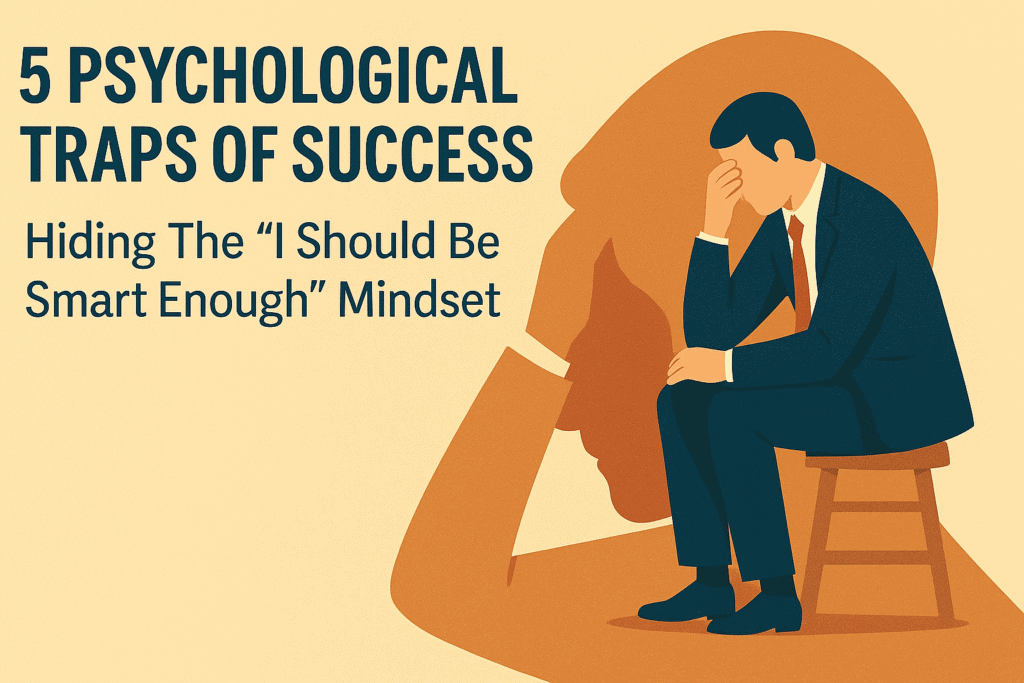
This is the first and most dangerous Psychological Trap of Success. Smart individuals often believe that because they were successful before, they should always succeed again—without needing help or adaptation.
Why this happens
- Intelligence is praised early, creating the illusion that effort isn’t necessary.
- Setbacks feel like personal failures instead of opportunities to learn.
- The ego blocks curiosity: “If I’m smart, I shouldn’t struggle.”
Consequences
- You avoid learning new skills that could elevate you.
- You fear asking for help or admitting mistakes.
- When failure arrives, you switch paths instead of persisting.
How to overcome it
- Recognize that intelligence without humility leads to stagnation.
- Adopt a growth mindset—focus on learning, not proving.
- Ask more questions than you answer.
- Measure progress by learning speed, not perfection.
💡 Read more: For a deeper dive, visit How to Overcome Ego Barriers in Leadership.
Link to next section: Trap #2: Identity = Achievement
3. Trap 2: Identity = Achievement
Among the most common Psychological Traps of Success is when your identity becomes defined by achievement. “I am my title,” or “I am the best at this.” But what happens when success slows or shifts?
The trap explained
According to Psychology Today, high achievers often tie their worth to output—a subtle form of self-sabotage. Similarly, writer Sahil Bloom describes how we begin serving our success instead of letting it serve us.
Why this leads to failure
- You resist growth that threatens your “successful” image.
- You burn out maintaining appearances.
- You fear failure more than you value experimentation.
How to break free
- Separate who you are from what you do.
- Build an identity around learning and curiosity.
- Redefine success as evolution, not perfection.
- Ask: “If I wasn’t defined by this title, what would I explore next?”
💡 Read next → The Psychology of Resilience in Business Success.
next section: Trap #3: The Success Comfort Zone
4. Trap 3: The Success Comfort Zone

After achieving early wins, many high performers enter a deceptive phase—the Success Comfort Zone. This is one of the Psychological Traps of Success that disguises comfort as mastery.
Signs you’re stuck
- Relying on old strategies that no longer apply.
- Avoiding change to protect your reputation.
- Confusing stability with satisfaction.
Why smart people fall for it
- They equate consistency with security.
- They fear risking their reputation.
- They mistake familiarity for progress.
Evidence & psychology
Entrepreneur Ankur Warikoo explains how “status quo bias” and “spotlight effect” trap achievers in their comfort zone. These biases limit innovation even when opportunities appear.
How to escape
- Treat success as a checkpoint, not a conclusion.
- Seek projects that make you slightly uncomfortable.
- Revisit your systems every six months to evolve with change.
- Remember: growth feels awkward before it feels right.
💡Explore How to Turn Failure Into a Growth Advantage.
Next: Trap #4: Overconfidence and Cognitive Biases
5. Trap 4: Overconfidence and Cognitive Biases
This Psychological Trap of Success is the silent killer of momentum. You focus on the win but forget the system that made it possible.
Why it hurts smart people
- They prioritize output over sustainable habits.
- They chase recognition instead of mastery.
- They rely on talent instead of daily systems.
How to fix it
- Audit your process monthly.
- Celebrate learning, not just wins.
- Build repeatable frameworks that evolve with you.
Explore systems thinking: Building Habits That Scale Success.
6. Trap 5: Ignoring Process for Results
Confidence helps you succeed—but overconfidence blinds you. This Psychological Trap of Success makes even brilliant individuals misjudge risks or ignore feedback.
Common biases
- Optimism bias: expecting positive outcomes regardless of data.
- Self-serving bias: claiming success as personal brilliance but blaming failure on others.
- Status quo bias: staying in familiar territory because change feels unsafe.
- Fear of success: subconsciously self-sabotaging when growth feels too visible.
Why it causes failure
- You underestimate new challenges.
- You dismiss constructive criticism.
- You rely on talent rather than systems.
How to fix it
- Ask: “What am I missing?” before big decisions.
- Invite honest feedback and opposing opinions.
- Regularly review data to counter personal bias.
- Cultivate humility—it strengthens decision-making.
💡 IRead more: For leadership advice, visit Cognitive Biases That Undermine Executive Success.
Next: Trap #5: Ignoring Process for Results
7. The Persistent Win: How to Break Free and Grow
When you chase only outcomes, you risk destroying the foundation that built them. This Psychological Trap of Success is subtle but deadly: focusing solely on results instead of refining the process.
Why it matters
- Results fade; processes sustain.
- When you neglect systems, burnout follows.
- Smart people forget that repetition and consistency are part of mastery.
What research shows
Psychology Today highlights that success-focused individuals often lose sight of “goal processes,” which undermines long-term fulfillment. Similarly, studies on habit formation show that consistency beats intensity over time.
How the persistent win
- Maintain rituals even after success (reflection, peer review, journaling).
- Track process metrics—consistency, iteration, learning rate.
- Celebrate progress, not just perfection.
- When goals evolve, update the process—not just the vision.
💡 Internal Link: Read: Building Sustainable Systems for Continuous Growth.
8. Conclusion
Success is not just about being smart. It’s about navigating the psychological terrain that comes with it. The five traps we covered—(1) the “I should be smart enough” mindset, (2) identity tied to achievement, (3) comfort zone of past success, (4) overconfidence and cognitive biases, and (5) ignoring process for results—are common reasons why smart people stall or fail in the long run.
But the persistent win. They legitimate their success by building systems, embracing discomfort, staying humble, and learning. They don’t just mark a single win; they build a trajectory. If you recognise yourself in any of these traps, consider this your wake-up call: success is not the destination—it’s the preparation for the next level.
Start today: revisit your mindset. Review your identity. Audit your routines. Ask the tough questions. Because smart people fail only when smartness alone is treated as sufficient. Smart plus persistent? That’s a winning formula.