
Table of Contents
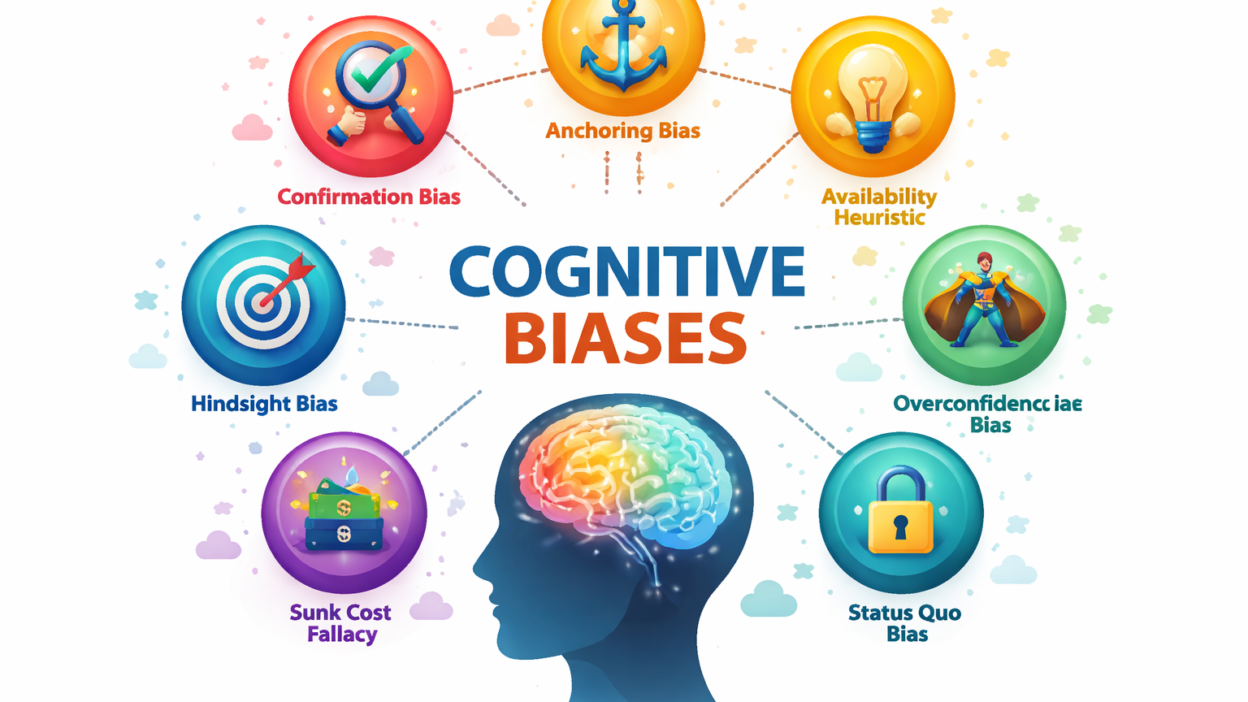
Every day, we face an endless stream of decisions, ranging from the simplest choices, like what to eat for breakfast, to the more complex ones, such as making career moves or financial investments. Most of the time, we go through these decisions automatically, believing that our judgments are purely rational and objective. However, hidden beneath the surface are subtle mental patterns that quietly guide the way we think and act. These patterns are called cognitive biases—systematic shortcuts or tendencies in our thinking that help us process information quickly but can also lead us astray.
Cognitive biases shape the way we perceive situations, interpret information, and ultimately decide, often without our conscious awareness. For instance, we might favor information that supports our existing beliefs, overestimate the likelihood of dramatic events, or stick to familiar habits even when change could bring better outcomes. While these biases evolved as mental shortcuts to simplify complex decision-making, they can sometimes result in errors, irrational choices, or missed opportunities.
By becoming aware of cognitive biases, we gain the power to step back and examine our thought processes more critically. This awareness allows us to question automatic judgments, consider alternative perspectives, and make choices that are more deliberate and effective. In both personal and professional life, understanding these hidden influences is a crucial step toward smarter decision-making, better problem-solving, and long-term success.
1. Confirmation Bias
Among the most common and influential cognitive biases is confirmation bias, the tendency to favor information that aligns with our preexisting beliefs while ignoring or dismissing evidence that challenges them. This bias is a central example of how cognitive biases shape human judgment, subtly influencing decisions across nearly every area of life—from how we consume news and social media content to how we make financial, career, or personal decisions. Understanding cognitive biases like confirmation bias is essential for making smarter, more deliberate choices. arxiv
Consider someone who believes that a particular diet is the key to optimal health. When they encounter articles or anecdotes supporting this diet, they are likely to accept the information without question, while disregarding scientific studies or expert opinions that contradict it. Over time, this selective exposure reinforces the original belief, creating a feedback loop. This is one way cognitive biases perpetuate themselves, making it harder to consider alternative perspectives or make objective evaluations.
In the workplace, confirmation bias can have significant consequences. Managers might make hiring or promotion decisions based on initial impressions, giving greater weight to qualities that confirm their expectations while overlooking red flags or contradictory evidence. Similarly, investors may pay attention only to news or analysis that validates their market predictions, ignoring signs of potential risk. These examples demonstrate how cognitive biases can influence professional decisions in subtle but impactful ways. acr-journal
Recognizing confirmation bias is a crucial step in mitigating the effects of cognitive biases on our thinking. Actively seeking diverse viewpoints, questioning assumptions, and deliberately considering contradictory evidence are strategies that help reduce this bias. By doing so, we can improve decision-making, enhance critical thinking, and foster intellectual growth.
In essence, confirmation bias is a natural and unavoidable part of human cognition, yet awareness of this cognitive bias allows us to pause, reflect, and make more balanced, informed choices. Understanding and addressing this bias is one of the first steps toward mastering the many cognitive biases that influence everyday decisions, enabling us to navigate life with greater clarity and purpose. ithy
2. Anchoring Bias
Among the many cognitive biases that shape human decision-making, the anchoring bias stands out for its subtle yet powerful influence. This bias occurs when people give undue weight to the first piece of information they encounter—the “anchor”—and let it disproportionately shape subsequent judgments. Anchoring is a classic example of how cognitive biases can operate below our conscious awareness, guiding decisions in ways we may not realize.
The impact of anchoring bias is widespread across personal and professional life. In financial decisions, for instance, the initial price of a product or an investment often becomes a mental reference point. Even when additional data or market research is available, individuals may adjust insufficiently from that first figure, leading to skewed judgments. This demonstrates how one of the many cognitive biases can directly influence perceived value and decision outcomes. arxiv
In hiring and performance evaluation, anchoring bias is equally powerful. The first impression of a candidate or employee can establish a mental benchmark that colors the interpretation of subsequent skills, qualifications, and behaviors. Without awareness, managers may unknowingly let this cognitive bias affect their assessment, favoring early perceptions over a holistic review of evidence.
Everyday decisions are not immune either. When evaluating news, statistics, or even product reviews, the first piece of information we receive can anchor our thinking. For example, if a report emphasizes a “90% success rate” early on, people may overestimate the likelihood of positive outcomes, even if later data suggests a more nuanced reality. This is a clear demonstration of how cognitive biases like anchoring subtly shape perception and judgment. ithy
Mitigating the influence of anchoring requires deliberate attention. By recognizing that anchoring bias is one of the many cognitive biases influencing our thought processes, we can actively seek multiple perspectives, analyze data objectively, and question whether our judgments are anchored to irrelevant or initial information. Conscious reflection allows us to make decisions based on comprehensive evaluation rather than the arbitrary weight of the first number, impression, or statistic we encounter.
Ultimately, understanding anchoring bias as a key cognitive bias empowers individuals to make more rational, deliberate decisions. Awareness of how this and other cognitive biases influence thought enables us to evaluate options fairly, minimize errors, and make choices that align with both personal and professional goals. acr-journal
3. Availability Heuristic
Another powerful mental shortcut in the realm of cognitive biases is the availability heuristic, which describes the human tendency to judge the likelihood or importance of an event based on how easily examples come to mind. In other words, our brains often rely on the most vivid, recent, or emotionally striking information when making decisions, rather than objective data. ithy
For instance, after seeing multiple news reports about airplane accidents, a person might overestimate the risk of flying, even though air travel is statistically far safer than driving. Similarly, hearing a friend’s story about a failing business might lead someone to wrongly assume that entrepreneurship is inherently too risky, despite evidence showing that careful planning and strategy often lead to success. In these cases, the brain substitutes easily recalled examples for a careful analysis of probability, which can skew perception and lead to poor decisions.
The availability heuristic also plays a role in daily decisions that seem trivial but have real consequences. When evaluating a new product, we might base our judgment on recent advertisements, social media buzz, or word-of-mouth reviews that are most accessible, rather than conducting thorough research. In finance, investors may react impulsively to market headlines without analyzing long-term trends, driven by the most readily available news. acr-journal
Being aware of the availability heuristic helps us pause and question our instinctive judgments. Instead of automatically relying on what is most memorable, we can actively seek out broader, more balanced information. This approach reduces the influence of emotional or anecdotal evidence and allows for more rational, data-driven decision-making.
In essence, the availability heuristic shows how cognitive biases subtly shape perception and behavior. Recognizing it empowers us to avoid overreacting to recent events, consider alternative scenarios, and make choices grounded in facts rather than the vividness of what immediately comes to mind. arxiv
4. Overconfidence Bias
Among the many cognitive biases that influence our decision-making, overconfidence bias stands out because it can affect both personal and professional choices in profound ways. Overconfidence bias is the tendency to overestimate our knowledge, abilities, or the accuracy of our predictions. Essentially, we often believe we know more than we actually do, or that our judgment is more reliable than it truly is. ithy
This bias can manifest in many areas of life. In the workplace, managers may underestimate the time or resources needed to complete a project, leading to missed deadlines or budget overruns. Investors might be overly confident in predicting market trends, risking substantial financial losses. Even in everyday situations, such as navigating traffic or making small purchases, overconfidence can cause us to make decisions without fully evaluating potential risks. arxiv
Overconfidence bias is particularly insidious because it reinforces itself. When people make decisions that initially seem successful, they may interpret the outcome as proof of their superior judgment, ignoring the role of luck, context, or external factors. Conversely, they may dismiss failures as anomalies rather than signals to reconsider their assumptions. Over time, this cycle can create blind spots, making it increasingly difficult to recognize errors in reasoning.
Recognizing overconfidence bias is essential for improving decision-making. By deliberately questioning assumptions, seeking feedback from others, and examining past decisions critically, we can temper overconfidence with humility and more realistic assessments. Tools such as pre-mortem analysis—imagining why a decision could fail before it is made—can also help counteract this bias and encourage careful planning. acr-journal
Ultimately, understanding cognitive biases like overconfidence empowers us to make more thoughtful, deliberate choices. While confidence is valuable, unchecked overconfidence can obscure reality, distort judgment, and lead to unnecessary mistakes. Awareness allows us to balance self-assurance with critical thinking, ensuring decisions are informed, rational, and well-grounded.
5. Status Quo Bias
Another subtle but impactful cognitive bias that shapes everyday decision-making is the status quo bias. This bias refers to our tendency to prefer things to remain the same, resisting change even when alternatives might offer better outcomes. Essentially, we favor the familiar over the unknown, often prioritizing comfort and predictability over potential gains. arxiv
The status quo bias can appear in many areas of life. In business, companies may continue using outdated processes or technologies simply because “that’s how things have always been done,” even when new methods could improve efficiency or results. In personal life, people may stick with routines, habits, or relationships that no longer serve them, avoiding change out of fear, uncertainty, or the effort required to adapt. Even small decisions, like keeping the same subscription service or continuing with a product brand, are often influenced by this bias. acr-journal
Psychologically, the status quo bias is linked to loss aversion—the idea that losses are felt more intensely than equivalent gains. Change inherently carries a risk of loss, which our brains interpret as threatening, making us naturally resist it. As a result, we may overlook the benefits of new opportunities or fail to innovate, both personally and professionally.
Overcoming the status quo bias requires conscious effort and self-awareness. One approach is to actively evaluate alternatives and quantify potential benefits and risks, rather than defaulting to the familiar. Setting clear goals and imagining the consequences of both action and inaction can help reduce the bias’s influence. Additionally, seeking input from diverse perspectives can challenge our assumptions and encourage more balanced decision-making. ithy
Recognizing the status quo bias as one of the many cognitive biases that influence behavior is essential for growth. By understanding our natural preference for familiarity, we can make more deliberate choices, embrace innovation, and pursue opportunities that may have seemed risky or uncomfortable at first—but ultimately lead to better outcomes.
6. Hindsight Bias
Among the many cognitive biases that shape our thinking, hindsight bias is particularly intriguing because it distorts how we view past events. Sometimes called the “I-knew-it-all-along” effect, hindsight bias occurs when we perceive events as having been predictable after they have already happened, even if there was little or no way to foresee them at the time. This bias can subtly influence learning, judgment, and decision-making, often without us realizing it. ithy
Hindsight bias is common in both personal and professional settings. For instance, after a project succeeds or fails, individuals may believe the outcome was obvious all along. A manager might insist that a strategy was bound to succeed, or conversely, that a mistake was entirely predictable, ignoring the uncertainty and complexity present during the decision-making process. In daily life, people may look back at investments, career moves, or relationships and convince themselves that the results were inevitable, overlooking the role of chance, timing, or unforeseen circumstances.
This bias can be problematic because it fosters overconfidence in our ability to predict future events. If we believe we “knew it all along,” we may underestimate risks, fail to learn from past mistakes, or make overly optimistic forecasts. Hindsight bias also affects how we evaluate others’ decisions, potentially leading to unfair criticism or misguided judgments, as we fail to account for the context and uncertainty they faced. acr-journal
To counteract hindsight bias, it is important to consciously reconstruct past events as they were understood at the time, rather than as they appear in retrospect. Documenting reasoning, assumptions, and available information when making decisions can provide a more accurate perspective later. Seeking input from others and considering multiple possible outcomes can also reduce the distortion caused by hindsight.
By recognizing hindsight bias as one of the key cognitive biases influencing our thinking, we can improve reflection, learning, and decision-making. Awareness of this bias helps us approach the past with humility, analyze outcomes more objectively, and make future decisions grounded in realistic expectations rather than distorted memories. arxiv
7. Sunk Cost Fallacy
One of the most pervasive cognitive biases influencing everyday decisions is the sunk cost fallacy. This particular bias occurs when individuals continue to invest time, money, or effort into a project, relationship, or venture simply because of the resources they have already committed, rather than assessing whether continuing is genuinely the best course of action. In other words, past investments—so-called “sunk costs”—unduly shape current decisions, often leading to irrational persistence and unnecessary losses. Recognizing this as one of the key cognitive biases is essential for improving decision-making and avoiding preventable mistakes. arxiv
The sunk cost fallacy manifests across multiple areas of life. In business, companies may continue funding failing projects or products because of the heavy investments already made, instead of cutting losses and reallocating resources toward more promising opportunities. In personal life, individuals may stay in unfulfilling relationships, persist with hobbies that no longer bring satisfaction, or retain financial investments that consistently underperform—all driven by the invisible pull of previously committed resources. Even minor decisions, such as finishing a meal or activity simply because time or money has been spent, reflect the subtle influence of this cognitive bias.acr-journal
Psychologically, the sunk cost fallacy is intertwined with loss aversion and the natural human desire to avoid regret. Admitting that past decisions were mistakes can feel uncomfortable, which encourages continued investment in the hope that earlier efforts will be justified. Unfortunately, this mental shortcut—like many cognitive biases—can amplify losses instead of mitigating them, subtly undermining rational decision-making.
Overcoming the sunk cost fallacy requires deliberate awareness of how cognitive biases operate in our thinking. One effective strategy is to focus on future benefits and costs rather than past investments when evaluating options. Questions such as, “If I hadn’t already invested, would I pursue this now?” help reduce emotional attachment and allow for clearer, more rational choices. Seeking external perspectives and objective feedback can also counteract this bias, providing a more balanced view less influenced by prior commitments.
Recognizing the sunk cost fallacy as a critical cognitive bias empowers individuals to make forward-looking, rational decisions. By consciously letting go of past investments and prioritizing future value, we can avoid unnecessary losses, optimize outcomes, and cultivate a mindset oriented toward growth, efficiency, and well-being. Awareness of this bias—and of cognitive biases in general—transforms how we approach both personal and professional challenges, guiding us toward smarter, more deliberate choices in every facet of life. ithy
Conclusion
Every day, our minds navigate an intricate web of choices, large and small, often under the influence of hidden mental shortcuts known as cognitive biases. From favoring information that confirms our beliefs, as seen with confirmation bias, to overestimating our knowledge through overconfidence, these biases subtly shape the decisions we make, often without our conscious awareness. Others, like the availability heuristic, status quo bias, hindsight bias, and the sunk cost fallacy, influence how we perceive risks, opportunities, and past experiences, sometimes steering us away from optimal choices.
The good news is that awareness is a powerful antidote. By understanding the nature of these biases, we can pause, reflect, and evaluate our decisions more critically. Actively questioning assumptions, seeking diverse perspectives, and grounding choices in objective data rather than instinct or habit are practical strategies to mitigate their impact. Awareness transforms our decision-making from reactive to deliberate, allowing us to balance intuition with reason.
In both personal and professional life, the implications of recognizing cognitive biases are profound. Leaders can make more strategic choices, investors can better assess risks, and individuals can improve relationships and life satisfaction by making more informed, rational decisions. Awareness also fosters humility, curiosity, and continuous learning—qualities that not only reduce errors but also enhance creativity and resilience in the face of uncertainty.
Ultimately, while cognitive biases are a natural part of human thinking, they need not dictate our actions. By identifying and understanding these mental shortcuts, we gain the ability to navigate everyday decisions with clarity, confidence, and foresight. The journey toward better decision-making begins with recognizing these hidden forces, reflecting on their influence, and consciously choosing paths that align with our goals, values, and long-term success.
Learn more : 6 Mental Shifts to Rewire Your Mind for Business Success