

Table of Contents
Business success rarely disappears in a single dramatic moment. Instead, it often declines gradually, hidden behind daily activity and routine operations. In many organizations, Business Growth begins to slow not because of one major failure, but because of a series of small strategic mistakes that go unnoticed or unaddressed. These mistakes may seem minor at first—an unclear vision, inefficient processes, or delayed decisions—but over time, their combined impact can weaken the company’s ability to expand, compete effectively, and respond to changing market conditions.
Leaders frequently become absorbed in short-term responsibilities such as managing teams, solving operational problems, or meeting immediate financial targets. While these tasks are important, focusing exclusively on daily execution can cause leadership to overlook deeper structural issues that directly influence long-term Business Growth. Without regular strategic evaluation, companies may continue operating with outdated systems, misaligned priorities, or inefficient workflows that silently limit their potential. As a result, the organization may appear stable on the surface while gradually losing momentum and competitive advantage.
Sustainable Business Growth does not happen by accident. It requires deliberate planning, a clear strategic direction, and a commitment to continuous improvement. Organizations must consistently evaluate their performance, identify weaknesses, and adapt their strategies to remain relevant in an evolving business environment. This includes investing in innovation, strengthening leadership, optimizing operations, and maintaining a strong focus on customer needs. Companies that fail to adopt this proactive mindset often find themselves reacting too late to challenges that could have been prevented.
Furthermore, disciplined execution plays a critical role in transforming strategy into measurable results. Even the best strategic plans cannot support Business Growth if they are not implemented effectively. Leaders must ensure that their teams understand organizational goals, remain aligned with priorities, and have the resources needed to perform at a high level. Consistency, accountability, and clarity are essential elements that enable organizations to move forward with confidence and purpose.
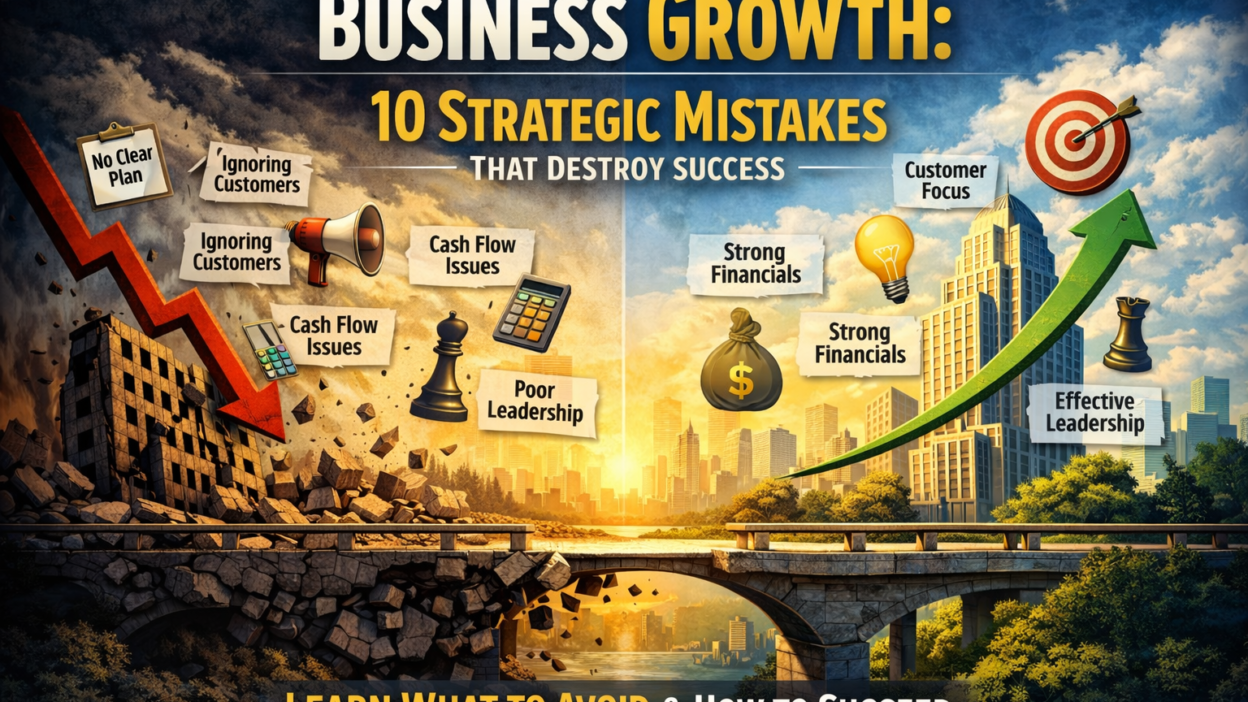
This article examines ten strategic mistakes that quietly and consistently undermine Business Growth. These mistakes are common across industries and affect businesses of all sizes, from startups to established enterprises. By understanding these hidden risks and learning how to avoid them, leaders can strengthen their organizations, protect their long-term performance, and create a strong foundation for sustainable and scalable Business Growth.
1. Lack of Clear Strategic Direction
One of the most damaging yet often overlooked obstacles to sustainable Business Growth is the absence of a clear and well-defined strategic direction. Many organizations operate with ambition and energy, but without a structured roadmap that guides their decisions and actions. When a company lacks a clear vision of where it wants to go and how it plans to get there, teams tend to focus on immediate tasks rather than long-term value creation. This reactive approach may keep the business running in the short term, but it significantly limits its ability to achieve meaningful and consistent Business Growth.
Without a defined strategy, decision-making becomes inconsistent and fragmented. Different departments may pursue their own priorities, resulting in misalignment and inefficiencies. Marketing may target the wrong audience, operations may invest in low-impact improvements, and leadership may allocate resources without a clear understanding of strategic priorities. Over time, this lack of alignment weakens organizational performance and prevents the company from building the momentum necessary for sustainable Business Growth. forbes
In addition, employees perform more effectively when they understand the broader purpose behind their work. A clear strategic direction provides teams with clarity, motivation, and confidence. It helps them see how their individual contributions support overall Business Growth, which improves engagement, productivity, and accountability. In contrast, when strategy is unclear or constantly changing, employees may feel uncertain, disengaged, or disconnected from the company’s long-term objectives.
Another critical issue is that companies without strategic clarity often struggle to prioritize opportunities. Not every opportunity contributes equally to Business Growth, and pursuing too many initiatives without focus can dilute resources and reduce effectiveness. A strong strategy helps leaders evaluate opportunities based on their long-term value and alignment with business goals, ensuring that time, capital, and effort are invested wisely.
To support consistent Business Growth, organizations must establish a clear vision, define measurable goals, and communicate strategic priorities across all levels of the company. Leadership should regularly review and refine the strategy based on performance data, market trends, and evolving business needs. By creating and maintaining a clear strategic direction, companies position themselves to make smarter decisions, align their teams effectively, and build a strong foundation for long-term Business Growth.
2. Ignoring Customer Needs and Feedback
One of the most critical yet underestimated threats to sustainable Business Growth is failing to truly understand and respond to customer needs. Customers are not only the source of revenue but also the most valuable source of insight for improving products, services, and overall business strategy. When organizations stop listening to their customers, they begin to operate based on assumptions rather than reality. Over time, this disconnect creates solutions that no longer align with market expectations, weakening competitiveness and slowing Business Growth.
Many companies believe they understand their customers simply because they have served them for years. However, customer expectations constantly evolve due to technological advancements, new competitors, and changing preferences. What worked in the past may no longer be sufficient to support future Business Growth. Businesses that fail to monitor these changes risk losing relevance, even if their current operations appear stable.medium
Ignoring customer feedback can also damage trust and loyalty. When customers feel unheard, they are more likely to explore alternative providers that better address their needs. This not only reduces customer retention but also increases acquisition costs, making Business Growth more expensive and difficult to sustain. Loyal customers, on the other hand, contribute significantly to long-term Business Growth by generating repeat business, referrals, and positive reputation.
Additionally, customer feedback often reveals hidden inefficiencies or missed opportunities. Complaints, reviews, and suggestions can highlight areas where processes, service delivery, or product quality need improvement. Companies that actively analyze and act on this information can strengthen their value proposition and accelerate Business Growth. In contrast, companies that ignore feedback lose the opportunity to improve and innovate.
To support continuous Business Growth, organizations must build systems to collect, analyze, and act on customer insights. This includes surveys, reviews, customer interviews, and performance data. More importantly, leadership must treat customer feedback as a strategic asset rather than a routine formality. By placing customers at the center of decision-making, companies can improve satisfaction, strengthen loyalty, and create a powerful engine for long-term Business Growth.
Learn more : 7 Storytelling Principles to Build a Brand Customers Never Forget
3. Resisting Change and Innovation
Resistance to change is another silent barrier that prevents organizations from achieving their full potential for Business Growth. In a rapidly evolving business environment, companies must continuously adapt to new technologies, market trends, and competitive pressures. Organizations that rely too heavily on past success often develop a false sense of security, believing that their current methods will continue to deliver results indefinitely. This mindset can delay necessary improvements and weaken the company’s ability to sustain Business Growth.
Innovation is not limited to creating new products. It also includes improving processes, adopting new technologies, enhancing customer experience, and optimizing internal operations. Companies that embrace innovation create more efficient systems, reduce costs, and increase value for customers—all of which contribute directly to stronger Business Growth. In contrast, companies that resist innovation often experience declining efficiency and reduced competitiveness.
One of the main reasons organizations resist change is fear of uncertainty. Leaders and employees may worry about disruption, temporary inefficiencies, or the risk of failure. However, avoiding change creates greater long-term risks. Markets do not remain static, and competitors that innovate faster can quickly capture market share and limit your company’s opportunities for Business Growth.pascalbachmann
Moreover, innovation strengthens organizational resilience. Businesses that continuously improve their capabilities are better prepared to respond to economic shifts, technological disruption, and changing customer expectations. This adaptability is essential for maintaining stable and sustainable Business Growth, especially in competitive industries.
Leadership plays a crucial role in fostering a culture that supports innovation. Encouraging experimentation, investing in modern tools, and empowering employees to propose new ideas can significantly enhance the company’s capacity for Business Growth. Organizations that view change as an opportunity rather than a threat position themselves to evolve, compete effectively, and achieve lasting Business Growth.
Learn more : 10 Powerful Ways Companies Reinventing Themselves in AI to Drive Growth and Innovation
4. Poor Financial Management
Financial management is one of the most fundamental pillars of sustainable Business Growth, yet it is often underestimated or poorly executed. Many businesses focus heavily on increasing sales while neglecting the financial structure needed to support expansion. Revenue alone does not guarantee stability. Without proper financial planning, budgeting, and monitoring, even fast-growing companies can encounter serious cash flow problems that disrupt operations and limit Business Growth. smallbusiness
One of the most common financial mistakes is failing to monitor cash flow consistently. A company may appear profitable on paper but still struggle to pay expenses due to poor timing between incoming revenue and outgoing costs. This imbalance can create operational stress, delay investments, and prevent the company from taking advantage of new opportunities that could accelerate Business Growth. Healthy cash flow ensures that the business can operate smoothly while investing in future expansion.
Another major issue is uncontrolled spending. Businesses sometimes invest in unnecessary tools, hire prematurely, or expand too quickly without validating demand. While growth initiatives are important, they must be supported by careful financial analysis. Poor spending decisions can reduce profitability and weaken the financial foundation required for long-term Business Growth.
In addition, many leaders fail to track key financial indicators such as profit margins, operating costs, and return on investment. Without this visibility, decision-making becomes reactive instead of strategic. Financial data provides critical insight into which activities contribute most to Business Growth and which areas require improvement or adjustment.pascalbachmann
To support strong and sustainable Business Growth, organizations must implement disciplined financial management practices. This includes maintaining accurate financial records, monitoring cash flow regularly, controlling costs, and making data-driven investment decisions. Companies that manage their finances effectively are better equipped to navigate uncertainty, seize opportunities, and maintain consistent Business Growth over time.
5. Weak Leadership and Decision-Making
Leadership quality has a direct and lasting impact on the speed and sustainability of Business Growth. Strong leadership provides clarity, direction, and confidence, while weak leadership creates uncertainty, confusion, and inefficiency. When leaders fail to communicate a clear vision or make timely decisions, the entire organization can lose momentum, slowing overall Business Growth.
One of the most damaging leadership weaknesses is indecision. In fast-moving markets, delayed decisions can result in missed opportunities, lost revenue, and reduced competitive advantage. Effective leaders understand that timely, informed decisions are essential to maintaining progress and supporting continuous Business Growth. Even imperfect decisions, when made quickly and adjusted as needed, are often more valuable than delayed inaction.
Poor communication is another major leadership challenge. When leaders do not clearly communicate goals, expectations, and priorities, employees may become misaligned or disengaged. This lack of alignment reduces productivity and weakens the organization’s ability to execute strategies that drive Business Growth. Clear communication ensures that everyone understands their role in achieving business objectives.
Additionally, weak leadership can negatively affect employee morale and motivation. Teams rely on leadership for guidance, support, and confidence. When leadership lacks consistency or direction, employees may lose trust and engagement, which directly impacts performance and limits Business Growth. medium
Strong leaders, on the other hand, create an environment of accountability, clarity, and continuous improvement. They empower teams, encourage innovation, and ensure that strategic priorities remain clear and actionable. By strengthening leadership capabilities and improving decision-making processes, organizations can build a solid foundation for sustainable and scalable Business Growth.
6. Lack of Operational Efficiency
Operational efficiency is a critical driver of sustainable Business Growth, yet many organizations operate with inefficient processes that quietly reduce productivity and profitability. Inefficiencies often develop gradually through outdated systems, duplicated tasks, poor workflow design, or lack of process standardization. While these issues may seem minor individually, their cumulative impact can significantly slow Business Growth by increasing costs, wasting time, and limiting scalability.
When processes are inefficient, employees spend more time managing problems instead of creating value. Tasks that could be automated are handled manually, communication gaps cause delays, and unclear procedures lead to repeated errors. These inefficiencies not only reduce overall performance but also prevent the organization from responding quickly to new opportunities that could accelerate Business Growth.forbes
Operational inefficiency also increases operational costs. When resources are not used effectively, businesses may need more staff, more time, and more capital to achieve the same results. This reduces profit margins and limits the organization’s ability to reinvest in innovation, talent, and infrastructure—all of which are essential for long-term Business Growth.
Another major consequence is limited scalability. A business cannot grow effectively if its internal systems cannot handle increased demand. Without efficient processes, growth creates stress instead of opportunity. Teams become overwhelmed, service quality declines, and customer satisfaction suffers, which ultimately weakens Business Growth.
To support consistent Business Growth, organizations must continuously evaluate and improve their operations. This includes identifying bottlenecks, simplifying workflows, automating repetitive tasks, and implementing efficient systems. Operational efficiency allows businesses to do more with fewer resources, improve performance, and create a strong foundation for scalable and sustainable Business Growth.
7. Hiring the Wrong People
People are one of the most important factors influencing the success and sustainability of Business Growth. Even with a strong strategy and efficient systems, the wrong team can limit performance and slow progress. Hiring employees who lack the necessary skills, motivation, or cultural alignment creates inefficiencies, reduces productivity, and weakens the organization’s ability to achieve its growth objectives.
Many companies make hiring decisions too quickly, focusing only on filling immediate gaps rather than selecting candidates who can contribute to long-term Business Growth. While this may solve short-term operational needs, it often creates larger problems in the future. Employees who are not aligned with the company’s goals or values may struggle to perform effectively, require excessive supervision, or negatively impact team dynamics.
Poor hiring decisions also increase turnover, which is costly and disruptive. Recruiting, training, and onboarding new employees require significant time and resources. Frequent turnover reduces stability and prevents the organization from building the strong, experienced team needed to support consistent Business Growth. In contrast, retaining skilled and motivated employees strengthens organizational capability and improves long-term performance.pascalbachmann
Additionally, the right employees contribute more than just task completion. They bring new ideas, identify opportunities for improvement, and help the organization adapt to change. These contributions are essential for innovation and continuous Business Growth. The wrong employees, however, may resist change, avoid responsibility, or limit the company’s ability to evolve.
To support sustainable Business Growth, organizations must adopt a strategic approach to hiring. This includes defining clear role requirements, evaluating both technical skills and cultural fit, and investing in employee development. Building a strong, capable, and aligned team creates a powerful foundation that enables organizations to grow efficiently and achieve long-term Business Growth.
8. Failing to Track Key Performance Metrics
One of the most overlooked obstacles to sustainable Business Growth is the failure to track and analyze key performance metrics. Without proper measurement, companies operate blindly, unable to determine whether strategies are working or identify areas that need improvement. Decisions made without data often rely on assumptions, which can lead to wasted resources, missed opportunities, and stagnation in Business Growth.
Key performance metrics, such as revenue growth, customer acquisition cost, retention rates, and operational efficiency, provide insight into the health of a business. Monitoring these metrics regularly allows leaders to identify trends, detect problems early, and make informed adjustments to strategies that support Business Growth. Without this insight, businesses risk continuing ineffective practices that quietly erode performance.forbes
Another critical aspect is accountability. Tracking metrics ensures that teams understand expectations and have measurable goals. It creates transparency, motivates performance, and allows leadership to recognize achievements and address shortcomings. Companies that ignore this step often see misalignment between departments, which slows execution and limits overall Business Growth.
To overcome this challenge, organizations must establish a robust system for collecting and analyzing relevant data. This includes setting clear KPIs, leveraging analytics tools, and reviewing performance frequently. By using metrics as a guide, companies can make data-driven decisions, optimize operations, and create a stronger, more predictable path to sustainable Business Growth.
Learn more : 6 Reasons Performance Optimization Matters More Than Design
9. Trying to Do Everything at Once
A lack of focus is a silent yet powerful threat to Business Growth. Many businesses attempt to pursue too many initiatives simultaneously, believing that expanding into multiple markets, launching multiple products, or chasing every opportunity will accelerate growth. In reality, spreading resources too thin often leads to diluted efforts, reduced quality, and missed targets, ultimately slowing Business Growth.
When an organization tries to do everything at once, teams struggle to prioritize effectively. Critical projects may be delayed, important improvements overlooked, and employees overwhelmed by competing demands. This lack of focus reduces productivity, increases operational stress, and diminishes the impact of individual initiatives on overall Business Growth. medium
Moreover, attempting too many initiatives can create confusion both internally and externally. Customers, partners, and employees may find it difficult to understand the company’s core value proposition, which weakens brand perception and slows Business Growth. Focused execution, on the other hand, communicates clarity and builds trust while enabling the company to deliver superior results.
To address this challenge, companies must prioritize high-impact initiatives that align closely with strategic goals. Limiting the number of simultaneous projects allows teams to concentrate on execution, optimize performance, and achieve measurable results. By focusing resources and attention on the most important areas, organizations can maximize efficiency and accelerate sustainable Business Growth.
10. Neglecting Long-Term Planning
Short-term thinking is one of the most subtle but damaging mistakes that can hinder Business Growth. Many companies focus excessively on immediate revenue, quarterly targets, or reactive problem-solving, often at the expense of long-term sustainability. While short-term gains can provide temporary success, neglecting long-term planning creates vulnerabilities that can compromise future Business Growth.
Businesses that fail to plan for the long term often overlook critical investments in innovation, talent development, technology, and infrastructure. Without these investments, they risk stagnation and fall behind competitors who are better prepared for evolving market conditions. Neglecting long-term planning also makes it difficult to anticipate challenges, respond to disruptions, or capitalize on emerging opportunities that could drive Business Growth. forbes
Additionally, companies with a short-term mindset may struggle to build scalable systems. Processes, workflows, and organizational structures designed for immediate needs may become inadequate as the business expands, causing inefficiencies and limiting Business Growth potential. Long-term planning ensures that growth is not only achievable but also sustainable.
To support enduring Business Growth, organizations must adopt a forward-thinking approach. This includes defining multi-year objectives, investing strategically in resources and capabilities, and continuously evaluating external trends and internal performance. By integrating long-term planning into decision-making, companies can create a resilient foundation that allows them to grow steadily and sustainably.
Conclusion
Sustainable Business Growth is rarely the result of chance. It requires careful strategy, disciplined execution, and constant attention to both internal and external factors. The ten strategic mistakes highlighted—lack of clear direction, ignoring customer needs, resisting change, poor financial management, weak leadership, operational inefficiency, hiring the wrong people, failing to track metrics, spreading resources too thin, and neglecting long-term planning—may seem subtle individually, but together they can quietly undermine a company’s potential.
Avoiding these mistakes involves deliberate effort: setting clear goals, listening to customers, fostering innovation, maintaining financial discipline, building strong leadership, optimizing operations, hiring strategically, tracking performance, focusing initiatives, and planning for the future. Companies that actively address these areas not only protect their existing Business Growth but also create the conditions for sustained, scalable, and resilient expansion.
By identifying and correcting these silent threats, businesses can ensure that every decision, investment, and action contributes meaningfully to long-term Business Growth, enabling them to thrive in an increasingly competitive and dynamic market.